
Something is shifting in the job market. Not slowly, not quietly, but in a way that is starting to touch almost every role, every sector, every path forward.
For a long time, “green jobs” sounded like something distant. Something technical. Something for specialists. That is no longer the case.
Today, the idea is much simpler and, in a way, much more hopeful. Every job is beginning to carry a green dimension.
Not a Niche Anymore
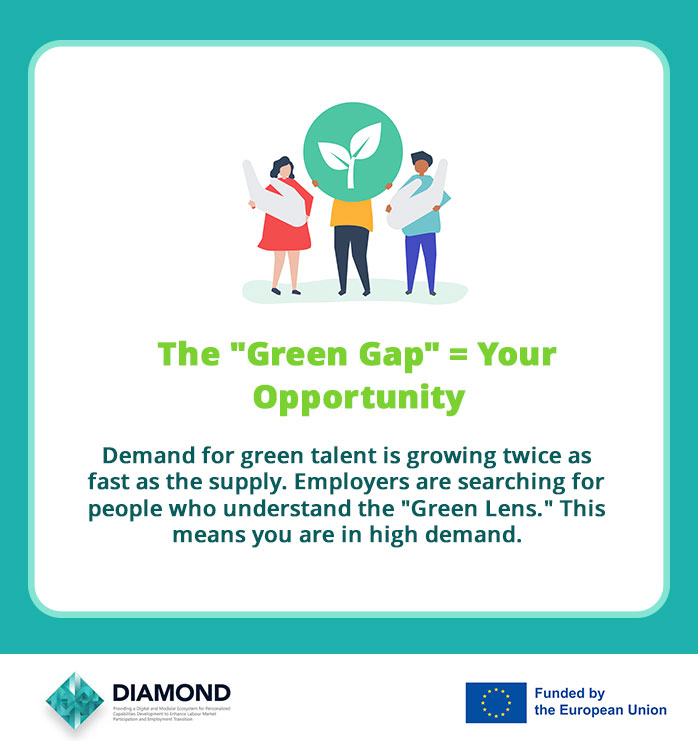
Recent insights show that demand for green skills is growing much faster than the number of people who actually have them. Not slightly faster. Roughly twice as fast. And yet, this is not a story about shortage. It is a story about opportunity.
Because what employers are really looking for is not a completely new type of worker. They are looking for people who can look at familiar tasks through a slightly different lens.
A project manager who thinks about efficiency. A buyer who considers sustainability. An office worker who understands resource use.
More than half of green hires are now happening in roles that are not labelled “green” at all.
This changes the picture entirely.
A Different Kind of Skill
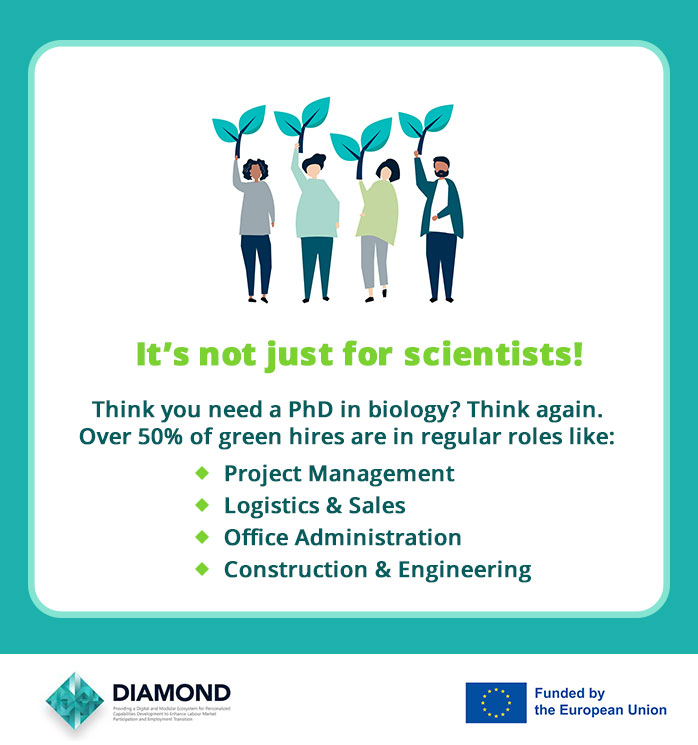
Green skills are often misunderstood. They are not only about environmental science or policy. In everyday work, they can be surprisingly practical.
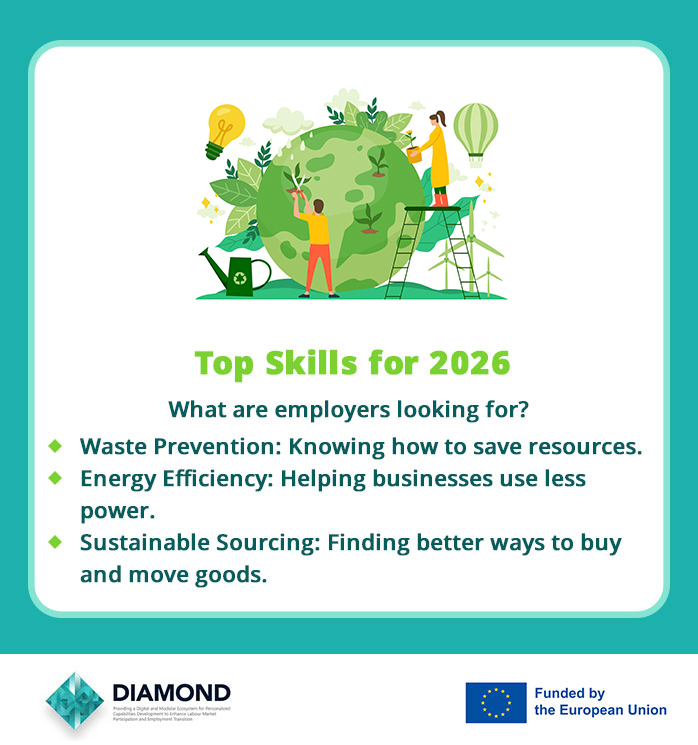
- Knowing how to reduce waste.
- Understanding how energy is used.
- Making better choices when sourcing materials or services.
These are not abstract ideas. They are decisions people make every day, often without realising their wider impact. And increasingly, these small decisions are what companies care about. Not only for environmental reasons, but because they are directly linked to efficiency, resilience, and long-term stability.
Where DIAMOND Comes In
This is where the DIAMOND project takes a different approach. Instead of treating skills as something fixed or imposed from the top, it starts with the individual. What are your strengths, your preferences, your starting point?
From there, the goal is to build what the project calls “transformative capabilities.” This includes both digital and green skills, but in a way that is tailored, flexible, and realistic.
Through micro-credentials, people can develop specific skills that match real labour market needs, not in a distant, abstract sense, but in a way that connects directly to actual job opportunities.
There is also something important behind this approach – access.
Green skills are still underrepresented in many training systems, even though they are becoming essential. At the same time, many people, especially those from more vulnerable backgrounds, are not always included in these transitions.
DIAMOND aims to change that by making these skills more accessible, more relevant, and easier to integrate into real career paths.
A Window, Not a Wall
It is easy to look at change and feel uncertain, especially when it comes to work.
But this shift towards green skills is not about closing doors. It is about opening them.
Adding even one sustainability-related skill can already make a difference. It can increase adaptability, improve job prospects, and create new directions that may not have been visible before.
The gap between demand and supply, often described as a problem, is also a space. And within that space, there is room to grow.
Looking Ahead
The green transition is often talked about in terms of targets, policies, or technologies, but at its core, it is about people.
People learning new ways of working.
People adapting what they already know.
People finding their place in a changing world.
And perhaps that is the most encouraging part.
You do not need to start from zero. You do not need to change everything.
Sometimes, it begins with one skill. One shift in perspective. One decision to move forward.
Source: Sustainability Magazine, How Green Skills Will Drive Global Jobs Growth in 2026
Funding Agency: European Research Executive Agency (REA)