What Shapes Employability in Europe?
Take Part in the DIAMOND Research Survey
What shapes a person’s ability to navigate today’s labour market?
Employment statistics can tell us a great deal about labour-market participation, unemployment, and workforce trends. But understanding employability also means looking at the individual: how people assess their own skills, how clearly they see their career direction, what opportunities and networks they can access, and how prepared they feel for a changing world of work.
As part of the DIAMOND project, the Institute for Work, Economic, and Social Psychology at the University of Vienna (UNIVIE) is conducting a European research survey examining factors associated with employability and labour-market behaviour.
The study explores work and attitudes toward it, alongside a range of personal, professional, digital, and socioeconomic factors that may be connected to how people experience and navigate the labour market.
The research contributes to DIAMOND’s broader evidence base for understanding empowerment and transformative capabilities and developing more personalised, human-centred approaches to employability, including the DIAMOND ᴱGROW Index.
What Does the Study Investigate?
Employability is not shaped by one factor alone.
The survey examines several interconnected dimensions that can influence how people understand their capabilities, opportunities, and position in the labour market.
These include:
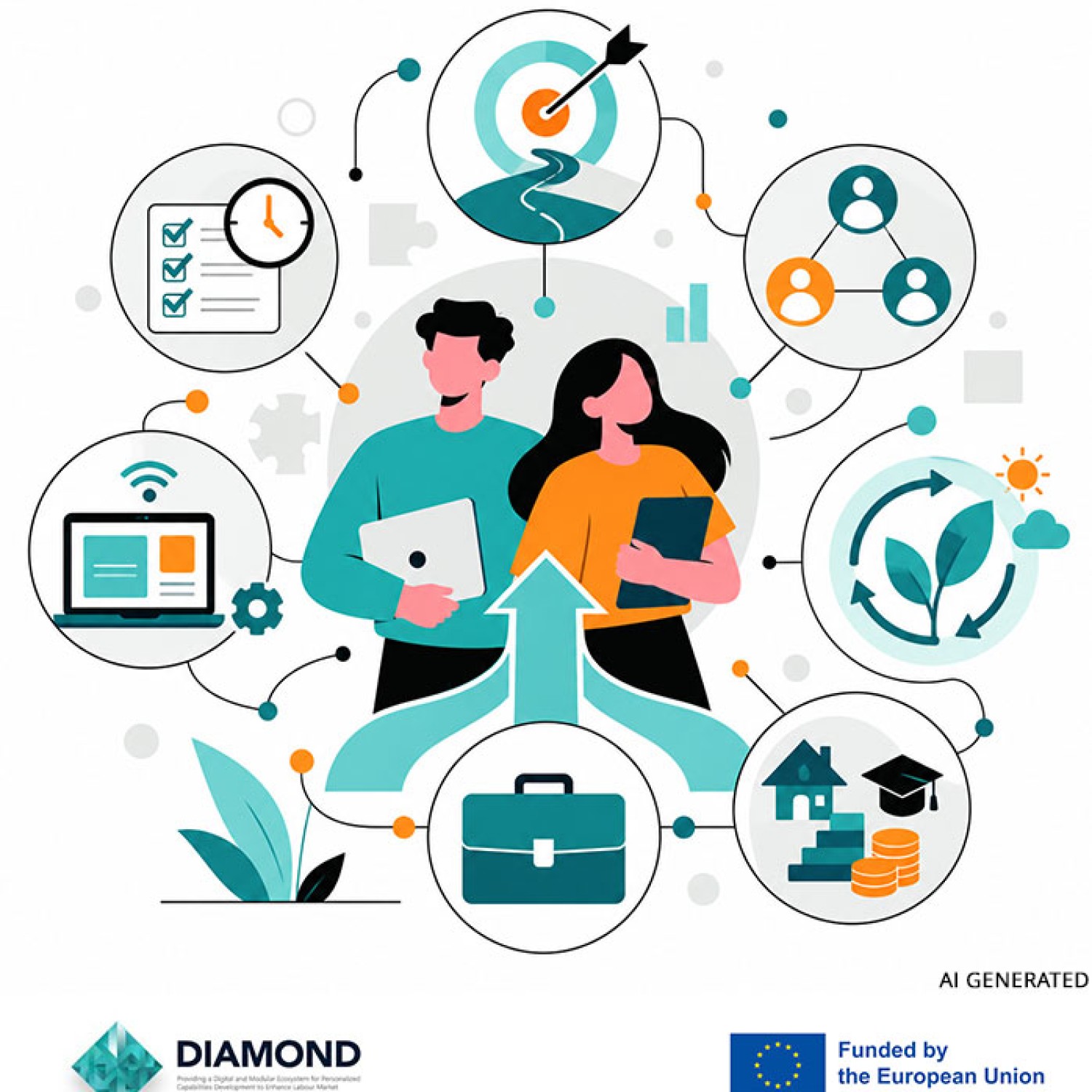
- Self-Assessed Skills and Employability: How people perceive their own capabilities and their ability to participate successfully in the labour market.
- Career Clarity and Future Opportunities: How clearly individuals understand their career direction and how they assess their future employment opportunities.
- Networking and Professional Connections: The role that professional and social connections can play in accessing information, support, and employment opportunities.
- Perceived Labour-Market Attractiveness: How people assess their own attractiveness and prospects within the labour market.
- Digital and Green Skills: People’s digital capabilities and their ability to understand and put sustainability-related knowledge and practices into action.
- Attitudes Toward Work: How individuals think about and relate to work and employment.
- Employment and Job-Search Experiences: Participants’ experiences with their current employment situation, work, and searching for employment.
- Socioeconomic Circumstances and Upbringing: How economic circumstances and socioeconomic background may relate to employability and labour-market experiences.
By examining these factors together, the study can provide a more complete picture of the different circumstances, capabilities, and perceptions that shape people’s pathways through the labour market.
Confidentiality and Scientific Integrity
The study is conducted strictly for academic and scientific purposes.
- Duration: The survey takes approximately 15 minutes to complete.
- Confidentiality: Responses are treated as strictly confidential, and research results are published anonymously so that data cannot be traced back to a specific individual.
- Voluntary participation: Participation is entirely voluntary, and participants may withdraw from the study at any time while completing the survey without providing a reason.
- Languages: The study is available in English, Portuguese, Italian, Polish, German, and Spanish.
Take Part in the Survey
To ensure broad European participation, the survey has been made accessible in six languages through our consortium partners:
- English: Take the English Survey
- Portuguese (Proportional Message): Take the Portuguese Survey
- Italian (EMiT Feltrinelli): Take the Italian Survey
- Polish (Deinde & Fundacja Obiektywna): Take the Polish Survey
- German (YP-DE): Take the German Survey
- Spanish (Fundación Miradas): Take the Spanish Survey
For academic queries or further information regarding the study methodology, please contact the University of Vienna research leads:
- Teresa Koch: teresa.koch@univie.ac.at
- Franziska Laaber: franziska.laaber@univie.ac.at
Funding Agency: European Research Executive Agency (REA)